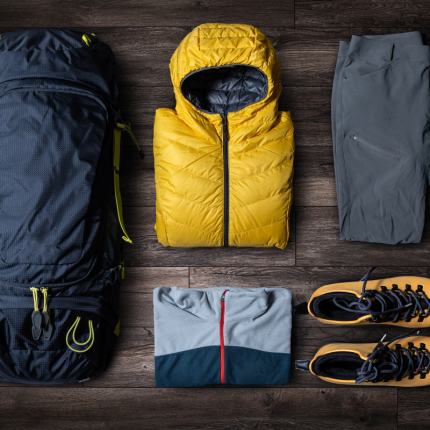

What gear should you bring on a hike?
Before packing your backpack, ask yourself one simple question: Do I have everything I need to set out with peace of mind, no matter the conditions? That’s the starting point for any good preparation.
Hiking Boots
We can’t stress this enough: hiking boots are the number one item you should invest in. A poor pair of boots is a surefire recipe for blisters, knee pain, and a hike ruined within the first few hours.
For a day hike on a marked trail, a low-cut or mid-cut boot is more than enough. Low-cut boots offer lightness and freedom of movement on easy to intermediate terrain. Mid-cut boots provide better ankle support on more technical or rocky terrain—a good choice if your route crosses unstable or uneven terrain.
The sole should provide sufficient traction depending on the type of terrain: moderate lugs for dry trails and forest paths, and deeper lugs for wet, muddy, or high-altitude terrain. A Vibram sole is the gold standard for durability and grip on rock.
Also considerwaterproofing: a Gore-Tex membrane or equivalent will keep your feet dry when crossing streams, on damp mornings, or during unexpected downpours. On the other hand, these models are slightly less breathable in extreme heat, so keep this in mind depending on the season and destination.
To provide maximum protection for your feet, opt for technical socks without protruding seams. They regulate temperature, wick away moisture, and protect your feet over time—a detail that makes all the difference on a long day of hiking.
Clothing for Your Day Hike
When hiking, the golden rule is the layering system. Don’t even think about setting out with just a thick, warm sweater or a single windbreaker: layer up with lightweight, functional garments that you can add or remove depending on the temperature, wind, and level of exertion.
The first layer to keep you dry during physical activity
The first layer is the one in direct contact with your skin. Its role is to wick away sweat to keep you dry and prevent you from getting chilled when you’re not moving. Opt for a technical T-shirt made of synthetic fabric (polyester) or merino wool; the latter has the advantage of naturally regulating body temperature and minimizing odors on long outings.
Avoid cotton at all costs. Once wet, it clings to the skin, loses all insulating properties, and makes you more susceptible to getting chilled. This is the most common mistake among beginner hikers.
The mid-layer to retain heat
The mid-layer— a lightweight fleece, merino wool jacket, or packable down jacket—acts as thermal insulation. It traps the heat your body generates while allowing moisture to escape outward.
For a day hike in summer conditions, a thin fleece is sufficient. For high-altitude hikes in the Alps during spring or fall, opt for a lightweight, packable down jacket: it packs down to a small ball in your backpack and can make all the difference during a break at the summit or if the weather turns bad.
The waterproof jacket: a must-have in all seasons
The waterproof jacket is the piece of gear that many leave at the bottom of their pack “because the weather is nice.” A classic mistake. In the mountains, the weather can change in twenty minutes: a blue sky in the morning doesn’t rule out a violent thunderstorm in the early afternoon.
Choose a jacket with a waterproof and breathable membrane—Gore-Tex, H2No, or equivalent—with a waterproof rating of at least 10,000 mm. Breathability is just as important as waterproofing: a jacket that isn’t breathable will soak you from the inside due to sweat, which amounts to the same result.
A windbreaker is a lighter alternative for outings with no risk of rain: it protects against the wind at high altitudes and dries very quickly. It’s ideal as a complement to a heavier waterproof jacket for varied routes.
Bottom half: pants or shorts?
For bottoms, the choice depends on the season and the terrain. Hiking shorts are ideal in warm weather on well-marked trails. Technical pants are a must as soon as the terrain becomes more challenging (brambles, rocks, dense vegetation) or when temperatures drop.
Some convertible pants, with zip-off legs that turn them into shorts, offer the best of both worlds. They’re practical, lightweight, and well-suited for days with significant temperature fluctuations due to elevation changes.
Don’t forget a cap or hat to protect yourself from the sun, and a lightweight beanie if your route takes you to higher elevations or if the forecast calls for wind and cold.
Backpacks: Choosing the Right Size
For a day hike, a 20- to 30-liter backpack is the ideal size. It’s large enough to carry all your essentials, yet compact enough to remain lightweight and comfortable during several hours of hiking.
Opt for a backpack with a hip belt and ergonomic shoulder straps; the hip belt transfers some of the weight to your hips, significantly relieving pressure on your back and shoulders over time. Make sure the hiking backpack is well-ventilated to prevent your back from overheating in hot weather.
Accessible exterior pockets are often an overlooked feature when making a purchase. Being able to grab your water bottle, phone, or a granola bar without taking off your backpack is a convenience that proves invaluable on the trail.
Be sure to bring a rain cover for your backpack, even if your model is advertised as waterproof. Backpack seams are rarely completely waterproof during a heavy downpour. A lightweight, compact rain cover weighs just a few grams and protects all of your belongings.
Hydration: Never Set Out Without Enough Water
Hydration is the most commonly underestimated aspect of day hikes. You might think, “It’s just a short outing; I have a bottle—I’ll be fine,” only to find yourself running out of water halfway through, in the heat or at high altitudes.
The basic rule: bring at least 1.5 liters of water for a 3- to 4-hour hike, and up to 2 to 3 liters in hot weather or on a route with significant elevation gain. Physical exertion in the mountains dehydrates you much faster than you realize, so start drinking before you get thirsty.
As for the container, there are two main options:
A rigid water bottle (stainless steel or food-grade plastic) is sturdy, easy to clean, and durable. A hydration bladder integrated into your backpack allows you to drink continuously through a tube without stopping—very convenient on technical trails where you’d rather keep up your pace.
If your route passes near streams or springs, a filter bottle allows you to safely refill with drinking water along the way. This is particularly useful gear for long hikes or routes in remote areas where springs are marked on IGN maps.
Safety: Equipment That Can Make All the Difference
The First Aid Kit
For a day hike, a lightweight first-aid kit is all you need. Essentials: bandages of various sizes, sterile gauze pads, antiseptic, elastic bandage, pain reliever, blister treatment, and a tick remover. These few grams can prevent a minor mishap from turning into a bad day.
The Survival Blanket
A survival blanket weighs between 50 and 100 grams and fits in the smallest pocket of your backpack. In the event of an injury that leaves you immobilized, hypothermia, or an unexpected overnight stay in the wilderness, it can help maintain your body temperature until help arrives. It’s the piece of gear you hope you’ll never need, but you never leave it at home.
The Whistle and the Phone
A whistle lets you signal your location in an emergency, even without cell service. Three whistles is the international distress signal in the mountains. Lightweight, compact, and essential.
Your phone must be charged and have emergency numbers saved: 15 (SAMU), 18 (fire department), and 112 (European emergency number, which works even without cell service in some areas). On certain high-mountain routes, 04 76 22 22 22 (PGHM des Alpes) is the direct contact number for mountain rescue.
? Good to Know: Before setting out, always let someone know your planned route, your starting point, and your estimated return time. In case of an emergency, this information allows rescue teams to respond quickly and go to the right location.
Sun protection: an essential piece of gear
The sun’s rays are much more intense in the mountains than in the lowlands, even on cloudy days. Altitude reduces the thickness of the filtering atmosphere, and the sun’s reflection off snow or rocks increases your exposure. High-SPF sunscreen (SPF 50+) is essential and should be reapplied every two hours.
Sunglasses with UV protection are just as important; at high altitudes or on snow, prolonged exposure without eye protection can cause a painful and debilitating corneal burn.
A cap or hat protects the face, head, and back of the neck. For high-altitude outings with a risk of cold winds, a merino wool neck gaiter provides both thermal protection and sun protection for the back of the neck.
Food: Eat Well to Go the Distance
For a day hike, there’s no need for a camping stove or freeze-dried meals: lunch and snacks can be easily prepared at home. The goal is to bring enough energy to last the entire hike without unnecessarily weighing down your pack.
Day-trip essentials: cereal bars or energy bars, dried fruits (almonds, walnuts, dried apricots), fresh fruits that are easy to carry, and a sandwich or wrap for the main meal. The idea is to eat regularly and before you feel hungry—every 45 minutes to an hour, depending on the intensity of the activity.
A few practical tips: store your snacks in the easily accessible side pockets of your backpack; avoid foods that melt (like chocolate in the summer) or that can get squished; and opt for high-energy-density foods for the best energy-to-weight ratio.
Conclusion
There you have it—you now have everything you need to pack your day hike backpack stress-free and without leaving anything behind. Proper hiking shoes, a well-thought-out layering system, adequate hydration, safety gear, and sun protection: each item plays a role, and the right gear is the kind you forget you’re even carrying on the trail.