

In this guide, we’ll explore five tips for improving your trail running, key workouts tailored to your level, common mistakes to avoid, how to structure a long-term training plan, and specific advice for uphill and downhill running, as well as pacing.

Building a Solid Endurance Base for Trail Running
Before we talk about interval training or VMA, there’s one essential prerequisite: developing your basic endurance. It’s the foundation on which everything else rests.
Why Basic Endurance Is Your Best Investment
Basic endurance means running at low intensity between 60 and 75% of your maximum heart rate. Ideally, with a heart rate monitor, you’ll stay in a zone where you can hold a conversation without getting out of breath. Many trail runners run too fast too soon, burn through their reserves, and hit a plateau. The rule to remember: 80% of your training volume should be at this intensity. This is known as the 80/20 rule, and it’s used by the world’s top endurance athletes.
In trail running, walking uphill at a steady pace counts as basic endurance training. Don’t feel guilty about walking—it’s a good strategy, not a weakness. On a long trail or an ultra-trail, top runners often walk steep hills to conserve energy and stay effective until the very end.
The goal is to finish the race, right?
Focus specifically on climbs
In trail running, building muscle strength on steep slopes is one of the most critical factors for performance. Climbing efficiently means conserving energy for the rest of the race, especially on long-distance courses with significant elevation gain.
Don’t struggle up the hill during the race
A few technical adjustments can help you tackle slopes more easily…
- Shorten your stride: short, quick steps are more efficient than long strides.
- Lean your upper body slightly forward from the hips and look 2 to 3 meters ahead to anticipate obstacles.
- Actively push off with your poles or swing your arms with a wide arc to propel your body upward. On steep slopes exceeding 15–20%, brisk walking is often more efficient than running; don’t try to run at all costs.
Three key sessions to improve your uphill running
Short hill session:
- After a 20-minute warm-up of light jogging, find a hill 100 to 200 m long with a steady 8–10% grade.
- Run up at 85–90% effort, then walk back down to recover.
- Do 8 to 12 sets.
This session is excellent for developing your maximum aerobic speed (MAS) on an incline. The session will last about 1 hour in total, including the cool-down.
Long hill session at threshold intensity:
- 30 to 45 minutes of continuous climbing at sustained effort on a steady incline
- A 10-minute cool-down of light jogging.
Conversation remains difficult but possible; you are working at your ventilatory threshold while running. This session, preferably outdoors on a real trail, will help you get used to sustaining your effort over time and managing your pace over long distances.
Hike-run session:
A1.5- to 2-hour hike-run sessionoutdoors, alternating between walking and running depending on the slope.
This long outdoor outing builds trail-specific muscular endurance, improves your breathing efficiency on inclines, and mentally prepares you for the trail running format.
Avoid scheduling two hill workouts in the same week early in your training. Hill work is very demanding on the calves, quadriceps, and tendons. The rest period between two intense sessions is not wasted time; that’s when your body adapts and makes progress.
Mastering Downhill Technique in Trail Running
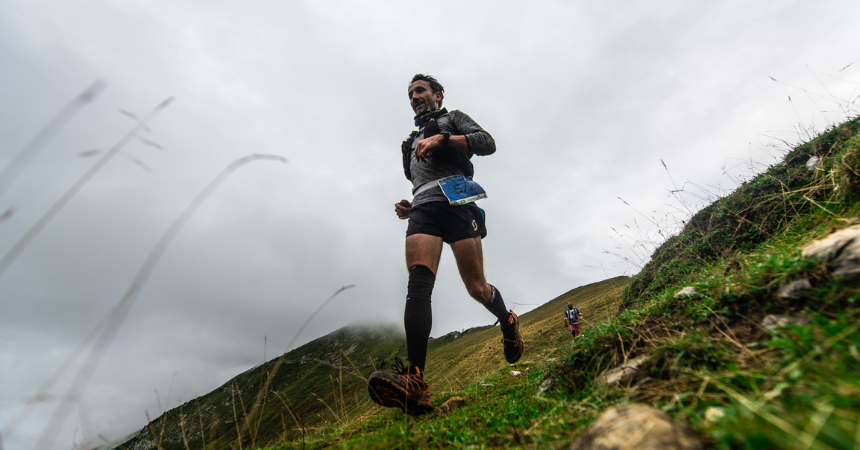
Downhill sections are where many trail runners lose time, energy, and sometimes confidence. However, good downhill technique can be learned, and it radically changes your trail running experience.
The basics of effective downhill running
It all starts with your gaze: keep your eyes focused far ahead, 5–10 meters in front of you, to anticipate the terrain and choose your footing without rushing.
Bend your knees slightly to absorb shocks and stay stable, and keep your upper body straight, or even slightly leaning forward. Don’t sit back—this is the number one mistake beginners make, and it unnecessarily tires your quadriceps while making it harder to breathe.
Trust your gear: a good pair of trail running shoes with traction suited to the terrain does most of the work for you. Finally, let the slope carry you rather than constantly braking; manage your speed by choosing your footing, not by resisting.
Eccentric training to prepare your muscles for the descent
Descending places massive demands on the quadriceps through eccentric work. The muscle contracts while lengthening to slow the movement. This type of effort is exhausting and often responsible for soreness the day after a run. To prepare your muscles, incorporate slow eccentric squats (3 seconds on the way down) into your general physical training ( GPT ), and perform bounding strides on a gentle downhill slope to get your legs used to repeated impacts.
Incorporating interval training into your workouts
Once you’ve built your endurance base—which takes at least 4 to 6 weeks of regular training—it’s time to ramp up the intensity. Trail interval training is the most effective way to improve your VO2 max and VMA, two key performance factors across all race distances.
Improving your VO2 max: what that means in practice
VO2 max represents the maximum volume of oxygen your body can utilize during exercise. The higher it is, the faster you can run for longer without tiring out. VMA, on the other hand, is the speed at which you reach that limit. Training at 90–100% of your VMA during interval sessions allows you to gradually raise that limit and improve your breathing capacity over the long term. Studies in sports physiology show that a 5–10% increase in VO2 max is achievable in 8–12 weeks of structured training.
Two VMA sessions tailored for trail running
30/30 short interval session:
- Warm-up: 15 to 20 minutes of jogging on flat or slightly hilly terrain, preferably outdoors.
- Session details: Alternate between 30 seconds at 100–110% VMA and 30 seconds of active recovery (light jogging). Perform 15 to 20 repetitions.
- Cool-down: 10 minutes of easy jogging, then do some stretches immediately after the session ends.
- Pre-workout tip: Remember to stay hydrated from the start and stick to soft ground to protect your joints.
Long interval session:
After a 20-minute warm-up, run 4 to 6 repetitions of 3 to 5 minutes at 90–95% of your maximum aerobic pace (VMA), with 2 minutes of recovery between each interval.
The session will last about 1 hour and 15 minutes in total. This format builds your ability to sustain prolonged effort and improves your pacing during a race.
In trail running, running slower during interval training than during road jogging isn’t a mistake—it’s a technical reality. Changes in terrain, stride length, and slope engage more muscle fibers. A trail interval session is therefore more effective than an equivalent session on the road or track.

Exploring PPG for Trail Running
Trail running is running, but it also involves a lot of core strength, balance, and power. A strong body runs more efficiently, gets injured less often, and handles steep terrain better. GPT (general physical training) is an integral part of trail running training, often overlooked by runners who prefer to rack up the miles.
Key muscle groups for trail running
The quadriceps and hamstrings handle the eccentric work on downhills, while the calves and Achilles tendons absorb shock and provide power on uphills. The glutes and abductors stabilize the pelvis with every stride, significantly reducing the risk of knee injury—a particularly important consideration for female runners, whose biomechanics make this area more vulnerable. Finally, the deep abdominal muscles maintain posture and reduce the energy cost of movement over long distances.
Improving at trail running: an adventure built step by step
The key takeaway: there are no shortcuts. Progress in trail running is the result of dozens of well-paced runs, restful nights of sleep, and consistent physical training. But it is also, and above all, a wonderful way to experience the mountains and nature in a whole new light.
For anything related to choosing trail running shoes or other essential running gear, feel free to stop by. The Speck-Sports team is here to help!