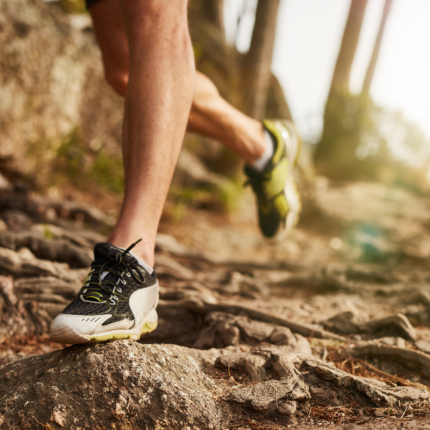

Let's take a look:
- The key differences between trail running and road running
- Criteria for making the right choice
- How to choose a model based on terrain and distance
Trail Running vs. Road Running: Why Your Road Running Shoes Won’t Cut It
You might have thought you could just keep your running shoes to tackle steep trails. Trail running and road running are two completely different worlds. The main difference lies in the stresses your foot experiences depending on the type of terrain.
A specific running profile
On the road, you have a stable and predictable surface. On the trail, it’s a different story: roots, rocks, mud, steep slopes, and uneven terrain. Your feet endure stresses that asphalt simply doesn’t provide. A trail running shoe is therefore characterized by protective features and traction elements you’ll never find on a classic road running shoe.
The exterior of a true trail running shoe features a deep lug sole, typically at least 4 to 6 mm deep, and sometimes up to 8 mm for extreme conditions. These lugs provide the best possible traction on loose, muddy, or slippery terrain, where a classic running shoe sole would remain smooth and ineffective. The rock plate at the front of the foot allows you to absorb impacts from rocks and roots without pain, an essential feature for ensuring comfort as you cover miles on technical trails.
Foot support is also crucial. The upper of a trail running shoe is reinforced to stabilize the foot on unstable terrain and limit ankle twisting. Lateral support is particularly important for absorbing unbalanced footfalls on banked sections—those spots where the trail slopes to one side. Finally, the materials used offer superior durability against the constant abrasion of technical terrain.
A standard running shoe will wear out prematurely on this terrain, slip on steep climbs, and won’t provide enough protection for your feet against the roughness of the trail. On a long mountain run, this can really make the difference between enjoyment and misery. That’s why buying a proper pair of trail running shoes is an essential investment.
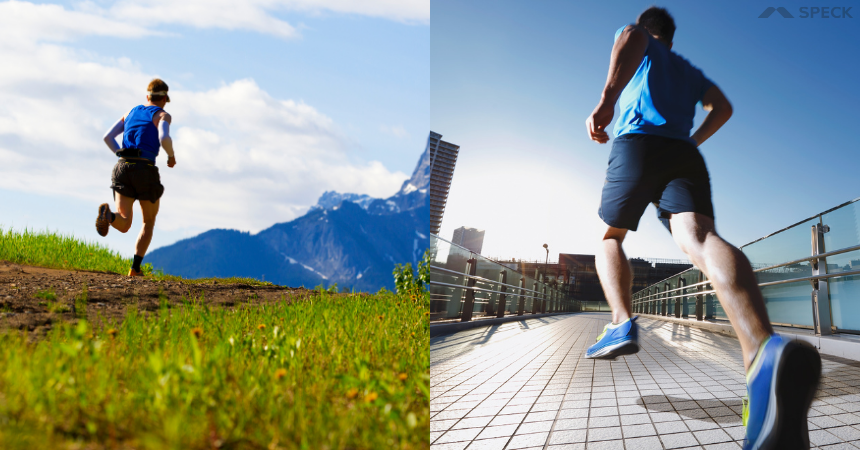
6 Criteria for Choosing Your Trail Running Shoes
First, you need to ask yourself what you’ll be using them for. At Speck-Sports, we’ve identified six essential technical criteria to consider before buying trail running shoes. These features will determine whether the pair you try on in the store truly meets your needs as a runner. Let’s take a look at how to evaluate each criterion to make the right choice.
1- Sole grip and traction
This is THE key to avoiding a fall on a descent! The outsole determines your ability to grip the terrain. Key factors to check: Lug depth: 3–4 mm for dry, rolling terrain; 5–6 mm minimum for mud and slippery ground; up to 8 mm for extreme conditions Lug pattern: multi-directional for varied terrain; rear-facing for ascents; spaced out for muddy terrain (self-cleaning) Sole rubber: opt for high-grip compounds like Vibram MegaGrip, Continental, or Contagrip, which provide traction even on wet rock
The Vibram MegaGrip sole offers approximately 30% more traction on wet surfaces compared to standard rubber. A real plus on technical terrain!
2- Cushioning: comfort and responsiveness
Cushioning is what absorbs shock with every stride. But be careful: more isn’t always better in trail running! The question of cushioning even divides experienced runners, as it all depends on your use and personal preferences. Maximalist shoes offer 30 to 35 mm of stack height, meaning the thickness of the foam underfoot. This type of generous cushioning absorbs a great deal of impact over long distances and on less technical terrain. Comfort is maximized, making it ideal for ultra-trails or hilly trails where you’ll spend many hours on your feet. On the other hand, you lose some ground feel and responsiveness, which can be a hindrance on technical sections. Medium cushioning, with a stack height between 20 and 25 mm, offers the perfect balance between protection and responsiveness for most runners. It provides enough cushioning to protect your joints without sacrificing responsiveness. This type of shoe is suitable for most running styles and distances and is often the best choice for a first pair of trail running shoes.
Minimalist shoes, with only 15 to 20 mm of stack height, offer maximum ground feel, impressive lightness, and exceptional responsiveness. But be careful: this type of shoe is intended for experienced runners and short runs. They require a refined running technique and well-strengthened calf and ankle muscles.
GOOD TO KNOW: If you’re new to trail running or coming from road running, opt for shoes with medium to maximum cushioning. Your joints will thank you! The transition to minimalist shoes should be gradual to avoid injuries.
3 - The drop: your posture at stake
The drop is the height difference between the heel and the forefoot. This feature directly influences your stride type and foot strike, and therefore your comfort over long distances.
A high drop, between 8 and 12 mm, promotes heel striking, relieves pressure on the Achilles tendon, and is particularly suitable for beginners and long distances. It’s reassuring when you’re starting out in trail running and allows you to run longer without overworking your calves.
A medium drop, between 4 and 7 mm, offers a versatile solution that encourages a more natural midfoot strike. Many trail runners find this category ideal, as it combines the advantages of both extremes without their drawbacks.
A low drop, between 0 and 4 mm, encourages a forefoot strike that places greater stress on the calves and Achilles tendon. This type of responsive shoe is primarily intended for experienced runners who have developed a specific technique and adapted musculature. It also aligns with the philosophy of brands like Altra, which offer only zero-drop shoes to promote running efficiency and a more natural stride.
Our key advice: stick close to the drop of your current shoes to avoid any risk of injury. A change in drop of more than 4 mm requires a gradual adjustment over several weeks. Switching abruptly from a 10 mm drop to a low drop of 4 mm or zero is a surefire recipe for tendonitis.
4. Foot Support and Stability
On uneven terrain, secure foot support is absolutely essential to prevent sprains and twists. This is crucial for mountain trail running, where every step can throw you off balance. The heel counter must be rigid to lock the heel in place and prevent it from sliding inside the shoe. This is particularly important on descents, when your foot tends to shift forward.
Key support areas:
- Heel counter: Must be rigid to lock the heel in place and prevent it from sliding inside the shoe
- Midfoot support: An effective lacing system that conforms well to the shape of your foot
- Lateral reinforcement: Prevents the foot from rolling sideways on uneven terrain
- Front toe cap: Protects your toes from frontal impacts against rocks and roots
To test a shoe’s support in-store, lace it up properly and try to rotate your foot inside. If your heel lifts or your foot moves too much sideways, move on and try another model.
5. Breathability vs. Waterproofing
Should you opt for a waterproof membrane like Gore-Tex or prioritize breathability? It depends on your running conditions. A breathable mesh upper quickly wicks away sweat, dries fast if wet, and remains lighter than a waterproof version. This type of shoe is perfect for summer trails, dry climates, short runs, and runners whose feet get very hot. The advantage of mesh is that even if your foot gets wet after crossing a stream, the shoe will dry out within a few miles.
The benefits of a breathable upper
- Quickly wicks away sweat
- Dries quickly if wet
- Lighter
- Ideal for: summer trails, dry climates, short runs, runners who get very hot
On the other hand, there’s the waterproof upper with a Gore-Tex membrane or equivalent that protects you from water and external moisture. It keeps your feet dry in the rain, which is a real comfort on fall and winter trails. However, it’s less breathable, with a risk of maceration if you sweat a lot. It’s also heavier, typically 50 to 80 grams more than a mesh version. This type of shoe is ideal for wet areas and long, rainy outings in cool conditions.
The benefits of a waterproof upper
- Protects against water and external moisture
- Keeps feet dry in the rain
- Less breathable, risk of maceration
- Heavier (+50 to 80 g)
- Ideal for: fall/winter trails, wet areas, long rainy outings
6. Shoe weight
Every gram counts when you multiply it by thousands of steps. The weight of your shoe directly affects muscle fatigue, especially over long distances. To give you some concrete benchmarks, here are the weight categories for a men’s size 42.
Ultra-lightweight shoes weigh between 180 and 230 grams. They are designed for competition and short trails, but require solid running technique and well-conditioned muscles. Lightweight shoes, weighing between 230 and 280 grams, offer a good balance between weight and protection for a variety of runs. They are often the best choice for regular runners looking for responsiveness without completely sacrificing comfort.
Intermediate models weigh between 280 and 330 grams. These versatile shoes offer a good balance for all distances and are suitable for most trail running activities. Finally, rugged shoes weigh over 330 grams, and up to 380 grams for some ultra-distance models. They prioritize maximum protection for highly technical terrain and ultra-trails where you’ll spend many hours on your feet.
Weight categories (example for a men’s size 42):
- Ultra-light: 180–230 g – For competition and short trails; requires solid technique
- Lightweight: 230–280 g — A balance of weight and protection for varied outings
- Intermediate: 280–330 g – Versatile, good balance for all distances
- Heavy-duty: 330-380 g+ - Ultra-distance and highly technical terrain, maximum protection
Keep in mind that a lightweight shoe requires more muscular effort from your foot and ankle. If you’re aiming for an ultra-trail or just starting out, prioritize comfort and protection over featherweight design. Your joints will thank you at the 30-kilometer mark.
Choosing the Right Shoe for the Terrain
The terrain you’ll be running on largely dictates the type of shoe you need. We’ll break it down by type of use to make things clear.
Rolling trails and forest paths
This type of terrain includes wide, relatively easy trails with moderate elevation changes and a fairly stable surface. We’re talking about forest paths, marked trails, and rolling single tracks found throughout France. It’s the perfect terrain for getting started in trail running and easing into the sport.
For this type of trail, the ideal shoe features a medium to high heel-to-toe drop, between 6 and 10 mm, which provides stability and relieves pressure on the joints. Moderate cushioning, with a stack height of around 20 to 25 mm, offers sufficient protection without weighing down your stride. The lugs can be moderate, between 3 and 4 mm, as the terrain remains fairly stable. In terms of weight, aim for a lightweight to midweight shoe, between 250 and 300 grams, to maintain dynamism. Opt for a breathable upper rather than a waterproof one, unless you run primarily in wet conditions.
The ideal shoe:
- Medium to high heel-to-toe drop (6–10 mm)
- Medium cushioning (20–25 mm)
- Moderate lugs (3–4 mm)
- Light to medium weight (250–300 g)
- Breathable upper
These are versatile shoes that excel on this type of terrain. You’re primarily looking for comfort and a smooth ride to cover miles without tiring out prematurely. Many trail runners spend most of their training on this type of trail.
Technical terrain and mountains
Technical mountain terrain is a whole different ballgame. We’re talking about rocks, scree, significant elevation changes, and sometimes even easy climbing sections. The ground is unstable, the slopes are steep, and your feet endure far greater stress than on a forest trail.
For these demanding conditions, protection becomes the top priority. The shoe must feature truly reinforced rock protection to withstand repeated impacts against rocks. Lateral support must be excellent to secure your ankle on sloping terrain. The sole must be sufficiently rigid to allow for precise footing on small rock holds, while featuring deep, multi-directional lugs of at least 5 to 6 mm.
The ideal shoe:
- Reinforced rock protection
- Excellent lateral support
- Rigid sole for precise footing
- Deep, multi-directional lugs (5–6 mm)
- Grippy Vibram-style rubber
- Weight: expect 300-350 g for protection
The sole rubber makes all the difference in the mountains. You should definitely opt for grippy compounds like Vibram that grip on both dry and wet rock. As for weight, expect 300 to 350 grams to get the protection you need. In the mountains, safety is far more important than lightness. Your ankles and toes will thank you for investing in a true technical boot suited for this demanding terrain.
Slippery and muddy terrain
Slippery and muddy terrain poses a real challenge for traction. You’ll find these conditions in damp woodlands, soggy meadows, marshy areas—basically any terrain where you risk slipping with every step if your shoes aren’t up to the task.
For these slippery terrains, lugs make all the difference. Look for models with very deep lugs, between 6 and 8 mm, to really bite into the mud. The lug pattern also matters a great deal: they must be spaced out to allow for self-cleaning. Studs that are too close together will clog instantly and turn you into a figure skater! The rubber should remain soft to better grip the moisture.
The ideal shoe:
- Very deep lugs (6–8 mm)
- Spaced-out lugs for self-cleaning
- Soft rubber that grips moisture
- Waterproof upper for winter conditions
- Flat sole that doesn’t trap mud
When it comes to the upper, this is where a waterproof membrane can really make a difference, especially for winter outings where you’ll be wading through mud and puddles for hours. The sole should remain relatively flat to prevent excessive mud buildup, which weighs down the shoe. Some brands offer models specifically designed for these conditions, with aggressive lugs and a mud-optimized design.
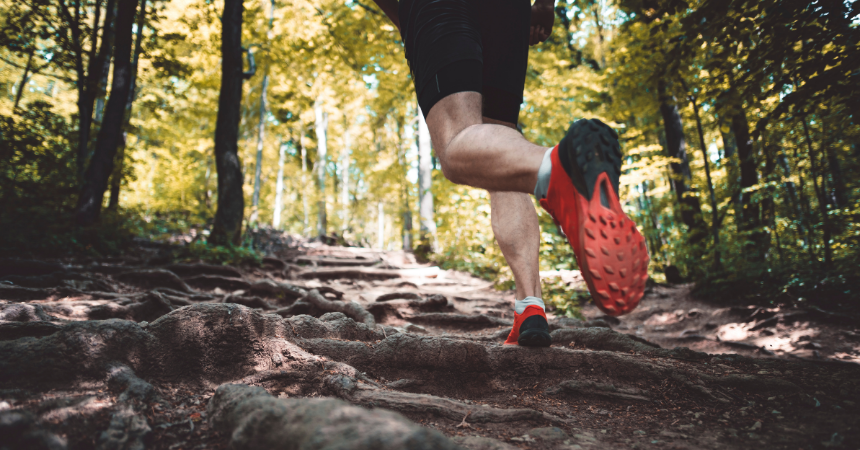
What shoes should you wear for an ultra trail race?
Ultra trails are runs that exceed the 42 kilometers of a marathon, often by a wide margin. We’re sometimes talking about 50, 80, 100 kilometers or more, with significant elevation gains sometimes measured in vertical kilometers. At these distances, comfort takes absolute priority over all other criteria. Your feet will spend 10, 15, or 20 hours in these shoes: they need to feel right at home.
For an ultra trail, you absolutely must prioritize maximum cushioning, with a stack height between 30 and 35 mm, to spare your joints over the long haul. Models like the Hoka Speedgoat or the Hoka One One Mafate are recognized leaders in this category: generous cushioning, an interior volume adapted to foot swelling over long distances, and proven durability. Forget minimalist shoes with carbon plates, designed for short, fast races: that’s the surest way to end up with wrecked knees by the 50th kilometer.
The shoe’s weight can easily range from 320 to 360 grams. Those extra 50 grams won’t make a difference in your final performance, but the comfort and protection they provide will be crucial. Also check the model’s proven durability: some shoes fall apart after 60 or 80 kilometers, while others easily handle 100 kilometers or more. Don’t hesitate to contact Speck Sports customer service for personalized advice on the models best suited to your goals.
Conclusion: Find the perfect fit!
There you go—you now have everything you need to choose your trail running shoes with confidence. Whether you’re looking for a pair for your first trail run, an ultra-distance race, or technical mountain runs, the essential criteria remain the same.
Still undecided between several models for your running style? Not sure of your ideal size or the width that will fit your foot? Need personalized advice based on your trail running goals and your runner’s body type? Come visit us at the Speck Sports store in Mulhouse! Our team of enthusiasts, including mountain guides and experienced trail runners, takes the time to analyze your specific needs. We’ll have you try on the right models, explain the technical differences, and give you honest advice based on your budget and goals. We’d love to help you find THE perfect pair to accompany you on all your trails.
Now it’s your turn—the trails are waiting!