
In this article, you’ll learn:
- How to clean each type of equipment
- Which products to use and which to avoid at all costs
- The key steps to follow after every ride
- How to spot signs of wear
- Best practices for storage
- How to wash your climbing gear
- When to replace your gear
Why is it essential to maintain your climbing gear?
Climbing puts intense strain on your gear. Friction against rock or indoor walls, exposure to sweat, moisture, dirt, and repeated impacts… Every climb leaves marks that are invisible to the naked eye but very real on the materials. Maintaining PPE (personal protective equipment)—which is how harnesses, ropes, and helmets are classified—is not an option: it is a safety requirement.
Deteriorated gear can fail without warning. This is why manufacturers like Black Diamond or Petzl set maximum service lives for each type of equipment, even when unused. Nylon ages, even in a closet. The resin in a sling becomes brittle under the effect of UV rays. The fibers of a climbing rope, composed of a load-bearing core and a protective sheath, gradually compress under the effect of repeated falls.
Maintaining your mountaineering or climbing gear is therefore much more than just keeping it clean. It means extending the lifespan of each piece of equipment, detecting damage early on that requires immediate removal from service, preserving the performance of each item (friction, strength, comfort), and, ultimately, saving money in the long run. A good reason to make it a habit starting today!
Caring for Your Climbing Rope
When it comes to gear maintenance, the rope is the most heavily used piece of your equipment. It absorbs the impact of falls, rubs against rock faces, and drags on the ground (when you don’t have a rope bag...). It also absorbs ambient moisture, dirt, and dust. Maintaining it is therefore clearly essential.
How do you clean your climbing rope?
Start by uncoiling the rope completely, laying it out in a coil on the floor, so you can visually inspect its entire length while washing.
Fill a bathtub or large basin with cold or lukewarm water (30°C maximum), then add a neutral rope-specific soap—several are available on the market—or a small amount of unscented Marseille soap. Run the rope through the water and gently scrub by hand or with a soft brush on the dirtiest areas. Then rinse thoroughly with clean water: there must be no trace of detergent left, as this would weaken the fibers over time.
Finally, let the rope dry completely flat, in the shade, in a dry, cool, well-ventilated area. Never store it damp in a rope bag.
Inspect your rope regularly
After cleaning, and generally after every outing, take the time to run your fingers along the entire length of the rope, section by section. Look for:
- Softer or flattened areas (core deformation)
- Cuts, fraying, or severed sheath fibers
- Abnormal stiffness or, conversely, excessive flexibility in a section
- Unusual discoloration (oil, chemicals, abseil burns)
If you detect any of these issues, take the rope out of service immediately. A damaged rope cannot be repaired.
Harness and straps: essential maintenance
The climbing harness is the interface between your body and the rope. As a textile product subject to PPE standards, it undergoes considerable stress during falls and can degrade in ways that are sometimes invisible. Whether you are the lead climber or the belayer, checking the condition of your harness before every climb is mandatory.
How to wash your climbing harness?
Washing a climbing harness follows rules similar to those for a rope. Use lukewarm water (30°C maximum) with a mild soap or detergent without fabric softener. Gently scrub the dirtiest areas—especially the comfort pads and straps—with a soft-bristled brush, then rinse very thoroughly with clean water. Detergent residue weakens nylon fibers over time. Let the harness air dry completely in the shade, either flat or hung up, in a cool, dry place. If you use a washing machine, select the delicate cycle at 30°C without spin, placing the harness inside a closed pillowcase to protect the metal buckles. Never use fabric softener; it penetrates the fibers and irreversibly reduces their strength.
Inspecting your harness: key checkpoints
After every outing, inspect thoroughly:
- The straps: look for fraying, cuts, abrasions, or thinning
- The connection points (buckle connecting the waistbelt to the leg loops): check for any deformation or wear on the reinforcement seams
- Adjustment buckles: operate each buckle; it must lock firmly without slipping
According to EN 12277 standards, a harness must be replaced every 10 years at most. However, in the event of a major fall, visible damage, or any doubt, replacement is immediate, without waiting for this deadline.
Climbing helmet: maintenance and inspection
The climbing helmet is the piece of equipment we tend to neglect… until the day it does its job. Whether for rock climbing, mountaineering, or even ice climbing in winter, it deserves special attention and regular maintenance.
Cleaning and inspecting your helmet
Helmet maintenance is quick and easy. After each outing, wipe the exterior with a clean, damp cloth lightly soaped, then rinse with clean water. For the interior, the removable foam and padding can generally be hand-washed in warm water with a mild soap. Let it air dry completely, out of direct sunlight, before storing the helmet in its protective cover.
Helmet Inspection Points
A climbing helmet protects against two types of impacts: falling objects (rocks, quickdraws) and head impacts against the rock face. Its integrity is therefore crucial.
After every outing and always after any impact, check:
- The outer shell: cracks, chips, deformations (even minor ones)
- The inner foam (EPS, expanded polystyrene): crushing, cracks
- The chin strap and its adjustments: strength of the fasteners, wear on the fabric
- The ventilation knob (on helmets with a dial): proper functioning
WARNING: A helmet that has suffered a significant impact must be replaced, even if it appears intact. The EPS foam absorbs impacts by deforming irreversibly, often in a way that is invisible from the outside. If in doubt, replace
Climbing Shoes: Caring for the Sole and Upper
Climbing shoes, sometimes simply called “shoes” in the climbing world, combine technical precision with delicate materials. The rubber on the sole is what provides grip on holds, whether on an indoor wall or on a rock face. This is the specific part that needs special care.
After each climbing session
As soon as you return from the gym or the crag, take a few seconds to remove dust and chalk residue from the soles using a clean, damp cloth. Chalk and dirt are the two main enemies of your shoes’ grip—a simple step that makes all the difference. Then air out your shoes by taking them out of your backpack: sweat creates moisture that damages the adhesives and promotes odors. If possible, stuff newspaper inside to absorb residual moisture and maintain the shoe’s shape. For a more thorough cleaning, wash by hand with cold water and a highly diluted neutral soap. Avoid prolonged soaking, which softens the adhesives, and use a soft-bristled brush on dirty areas. Dry completely in the open air and in the shade—never in direct sunlight, and never in a dryer, which irreversibly damages the adhesives and distorts the shoe’s fit.
GOOD TO KNOW: The rubber sole of your climbing shoes can be resoleed! Instead of buying a new pair when the rubber is worn out, consider having them repaired.
Carabiners and belay equipment
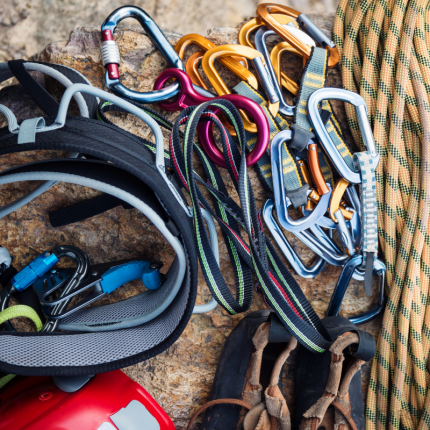
Belay and climbing gear, including carabiners, nuts (or “friends,” in climbing jargon), slings, and descenders, have a long lifespan provided they are properly maintained. Dirt and sand that get into the mechanisms are their main enemies.
Cleaning and maintaining your carabiners
After every outing in mixed terrain or the mountains, and especially after ice climbing in winter, where salt and lime attack metals, rinse your carabiners thoroughly with clean water. For screw-lock carabiners, rotate the mechanism under running water to dislodge embedded particles. Dry them completely before storing: even anodized aluminum is not immune to corrosion over the long term if moisture remains trapped. A drop of dry oil (such as paraffin oil) on the gate and the cam helps lubricate the mechanism, but avoid greasy oils, which attract dust and cause further buildup.
Storing Your Gear to Keep It in Good Condition
Maintenance isn’t just about cleaning. How you store your gear between outings directly impacts its lifespan, and this is an aspect often overlooked, even by experienced climbers.
The golden rule is simple: your gear should be stored in a cool, dry place, away from direct light. UV rays degrade nylon and other fabrics much faster than you might think, even through a window. A well-ventilated basement or a dedicated storage cabinet works perfectly. Store your climbing ropes in a large loop or in a rope bag rather than in tight coils, which create weak spots over time. Your climbing shoes should be stored flat or lightly padded with newspaper; never fold them or wedge them under other gear.
Special care must be taken with chemicals. Gasoline, solvents, paint, and even their vapors can weaken textile fibers invisibly and irreversibly. The trunk of a car, often used as a climber’s changing room, is therefore a place to avoid at all costs: the combination of extreme summer heat, fuel fumes, and UV exposure makes it a particularly harsh environment for all your climbing and mountaineering gear.
Finally, consider keeping a logbook or noting on a label the purchase date of each piece of equipment, the number of outings, and any incidents. This is an essential habit to ensure replacement at the right time, and it is often required by mountaineering clubs and organizations that manage shared equipment.
When should you replace your climbing gear?
This is often the hardest question to answer. We get attached to our gear, and we don’t want to spend money. However, certain signs require immediate replacement, regardless of the price paid or the age of the equipment.
The rule is simple: replace immediately if the gear has suffered a violent impact or a significant fall (even without visible damage), if you’ve detected a structural defect, cut, deformation, corrosion, or fraying on the sheath or core of a rope, if it has been exposed to chemicals, or simply if any doubt remains. In the world of climbing and mountaineering, doubt alone is enough to justify taking the equipment out of service. There are no temporary fixes or workarounds—such as tape on a damaged sheath—that can substitute for a replacement.
Take care of your gear, and it will take care of you
Maintaining your climbing gear is neither complicated nor time-consuming. It’s primarily a habit to get into—a few simple steps after each outing that make all the difference in the long run.
To summarize the key points of this guide:
- Clean ropes, harnesses, helmets, and climbing shoes regularly with warm water and mild soap
- Inspect your gear after every outing and after any impact or incident
- Store your gear away from UV rays, moisture, and chemicals
- Follow the manufacturers’ maximum service life guidelines
- Replace without hesitation if in doubt
And if you have any doubts about the condition of your gear, come see us in the store.