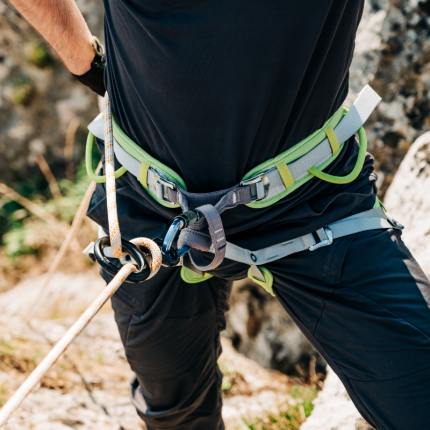

Also known as a climbing harness, it secures your rope, supports you in the event of a fall, and determines your overall comfort while climbing. With dozens of models available on the market (adjustable harnesses, non-adjustable harnesses, lightweight, padded…), it’s hard to know where to start without a good guide.
Don’t panic—that’s exactly why we’re here at Speck Sports.
In this comprehensive guide, we’ll cover:
- The different types of harnesses and the function of each component
- How to choose the perfect size for your harness
- Which climbing harness to choose based on your needs
Climbing harnesses: the different models
First, you need to ask yourself what you’ll be using it for. The choice of a climbing harness depends primarily on the type of climbing you do. Let’s take a look at the main categories.
Non-adjustable harness (1 buckle): lightweight and simple
This model of harness features a fixed waistbelt and non-adjustable leg loops. It is selected based solely on waist size, making it very quick to put on.
Advantages: lightweight, compact harness, ideal for indoor and outdoor climbing.
Disadvantages: not well-suited if you wear multiple layers or have an atypical body type.
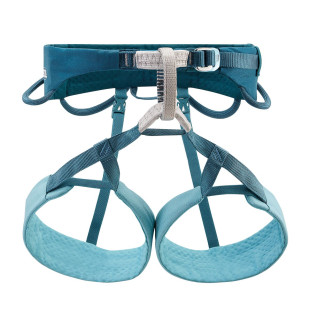
Adjustable harness (3 or 4 buckles): the versatile choice
The adjustable harness is the most common on the market. The waistbelt and leg loops are independently adjustable, allowing it to adapt to all body types and different layers of clothing.
Ideal for beginners, whether climbing indoors or on the crag.
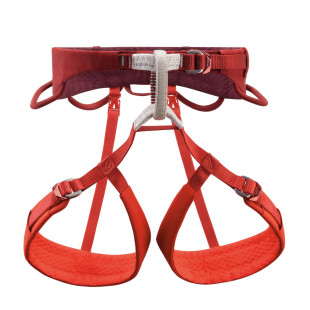
Harness: What’s the Difference? None! Both terms refer to the same piece of equipment. “Climbing harness” is the official technical term (used in standards), while “baudrier” is the common term in France. We use both interchangeably in this guide.
Anatomy of a climbing harness: the role of each component
Understanding the functions of each part will help you read a product spec sheet and compare models with confidence.
The Harness Waistbelt
The waistbelt is positioned at the pelvic level, that is, above the hip bones and not at the waist. It bears the bulk of the weight when suspended.
The wider and more padded it is (padding thickness and strap width are the two key criteria), the more comfortable the harness will be when suspended. The thermoformed foam conforms to the climber’s body shape; the wireframe promotes ventilation in hot weather.
The leg loops
They keep the harness in place and complement the support provided by the waistbelt. Their padding directly affects comfort while suspended, especially when belaying at a belay station.
Padded straps (thick padding) are best for multi-pitch routes and mountaineering. Lightweight, elasticated straps are suitable for indoor climbing and sport climbing. Freedom of movement also depends on a good fit of the leg loops.
The rope loop
The rope loop is the central component of the harness. This is where you tie your climbing rope and attach your belayer. There are two configurations:
- Single loop: simple, lightweight, ideal for sport climbing
- Double loop: two rings for belaying on multi-pitch routes or mountaineering
Gear loops
These plastic-coated loops on the sides of the waistbelt allow you to clip carabiners, quickdraws, chalk bags, belay devices, or nuts. The number ranges from 2 gear loops (ultralight harnesses) to 6 gear loops on multi-pitch and mountaineering models.
For ice climbing and mountaineering harnesses, loops for ice screw holders are also included, an essential technical feature for this type of climbing.
What size harness should you choose?
The fit of the harness is as much a safety consideration as it is a comfort one. A harness that is too large may slip off in the event of an inverted fall; a harness that is too small will constrict you and restrict blood flow.
How to measure your waist and thigh circumferences
Harness sizes are based on two precise measurements:
- Measuring your waist circumference: Measure around your pelvic waist, at the iliac crests (the bony protrusions of the hips). This is where the waistbelt sits, not at the navel
- Thigh circumference: measure at the widest part of the thigh, with the tape measure lying flat
Each brand has its own size guide with precise measurements. Never rely on your clothing size; measurements vary from brand to brand.
Adjusting the harness: the two-finger rule
Once the harness is on, checking the fit is simple: you should be able to slide two fingers flat under each strap, including the waist belt and thigh straps. No more, no less.
The perfect harness fit is one where you feel supported without being constricted, with full freedom of movement across all joint ranges.
What makes a comfortable harness?
Comfort and safety are closely linked. An uncomfortable harness distracts, causes fatigue, and compromises technique. Here are the selection criteria you shouldn’t overlook.
Strap width and padding thickness
Strap width and padding thickness are the two factors that determine comfort while hanging. For indoor climbing or sport climbing, light padding is sufficient. For multi-pitch routes or challenging climbs where you spend time sitting at belay stations, a wide, generously padded harness becomes essential.
Weight distribution and improved comfort
A good harness should distribute weight evenly between the waistbelt and the leg loops. If you feel pressure points on your hips or inner thighs after 10 minutes of belaying, it’s a sign that the model doesn’t fit your pelvis or body type.
To improve everyday comfort, also consider breathability: in the summer or indoors, a belt that’s too thick can become stifling.
Freedom of movement: test before you buy
Lift your knee, spread your leg, do a full squat. If you feel any resistance or pinching, try a different size or model. Freedom of movement is essential for technical climbing, and you can only really tell by wearing it.
Which harness for which discipline?
Let’s explore how to choose the right harness for your discipline. From the most accessible to the most demanding, here’s our breakdown.
The best harness for indoor climbing
For indoor climbing, the ideal harness is above all lightweight and easy to slip on quickly between routes. A lightweight, non-adjustable or adjustable harness with moderate padding is more than enough.
You don’t need many gear loops; two are enough for your quickdraws when they aren’t already in place on the route. The focus should therefore be on comfort for long climbing sessions, and on how easy it is to tighten and loosen the harness between routes.
The Harness for Rock Climbing
For rock climbing, an adjustable harness with well-padded waistband is ideal. Your safety and comfort during long falls depend directly on the quality of the chest strap and shoulder straps.
You can start by looking at models with 4 gear loops to attach quickdraws and a chalk bag without overloading the harness.
What about multi-pitch routes?
After a long day of climbing in the Écrins, you’re at the belay station for the fifth pitch, suspended in mid-air. That’s where the harness can make all the difference.
For multi-pitch climbing, opt for a well-padded harness with a double-strap design and 4 to 6 gear loops. The wide waistbelt and padded shoulder straps allow you to hang for extended periods without discomfort. Safety and comfort go hand in hand here.
Mountaineering, ice climbing, and ski touring
At high altitudes and in winter conditions, priorities shift: lightness, ease of donning with multiple layers of clothing, and loops for ice screw holders. A 4-buckle adjustable harness with openable straps is nearly indispensable for adapting to layered clothing.
For demanding ski touring and mountaineering, a harness weighing 200 to 350 grams is the standard for performance models. You’ll appreciate every gram saved during a long ascent.
Choosing a harness based on your body type
Men’s and women’s harnesses: the differences
The distinction between men’s and women’s harnesses isn’t just a marketing ploy. A men’s harness features a standard waist-to-thigh ratio; a women’s harness incorporates a flared waist and pre-angled thigh straps to accommodate a wider pelvis.
If you’ve tried unisex models without ever feeling truly comfortable, it might simply be a matter of fit! Brands like Petzl, Black Diamond, and Mammut all offer lines designed specifically for the female body.
Children’s Harness: Safety, Fit, and Adjustability
For children, a children’s harness must include a mandatory back strap to prevent the child from flipping upside down in the event of a fall. This is the main difference from an adult harness.
When choosing a children’s harness, check:
- The adjustment range: an adjustable model will last the child several seasons
- The back strap: absolutely essential—it’s a matter of child safety
- The fit for children: it must be easy to adjust on their own, with user-friendly buckles
- The weight: a lightweight harness allows for a more natural climb for smaller climbers
The best children’s harness is the one that fits them well today, not one intended for two years from now—which would be too big and therefore dangerous. Bring your child to the store: we’ll take the time to check the fit together.
For children’s climbing, some manufacturers offer adjustable harnesses with a connection system between the waist and chest (full-body harness). They provide maximum safety for children under 6 or those of smaller stature. Our team can advise you based on your child’s age and climbing style.
How long does a climbing harness last? When should you replace it?
The lifespan of a harness depends on how often it is used and how it is stored.
General guidelines:
- Up to 10 years from the date of manufacture, even if unused
- 1 to 3 years with intensive use (clubs, schools, professional guides)
- Replace immediately after a long fall or a violent impact, even if there is no visible damage
- Replace as soon as signs of wear appear: fraying seams, deformation of the chest strap, damaged buckles
There you go—you now have everything you need to choose your harness and head out on the routes with confidence.
The entire Speck team is available in-store to help you find the perfect model and advise you on the rest of your climbing gear.
Come visit us—we’re waiting for you!