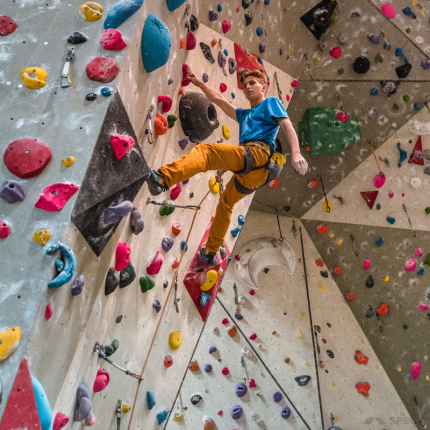

Watching a video, hitting the gym, building endurance on a stationary bike... There are plenty of ways to improve your bouldering and multi-pitch climbing skills—and simply learn to climb more efficiently.
Here, we’ll simply review the basics of climbing so you can improve with each session.
Three Fundamental Pillars for Improving Your Climbing
Before discussing exercises and training, it’s important to understand one fundamental thing: improving in climbing means improving on three fronts at once— technique, physical strength, and mental strength. Neglecting any one of these three is a surefire way to hit a plateau—which can be frustrating—in the short or medium term. Climbing is a comprehensive sport that requires a combination of skills that few other sports demand in such a simultaneous way.
The good news is that these three dimensions reinforce each other. A climber who improves their route reading expends less physical effort and puts less strain on their joints.
A climber who better manages their mindset at height climbs more fluidly and makes better decisions on the holds. Little by little, this approach allows for significant progress and the development of true self-confidence on the wall.
In climbing, technique trumps physical strength, especially at the beginner and intermediate levels. The vast majority of climbers who hit a plateau lack climbing technique more than they lack muscle. Before investing in a campus board or a hangboard, ask yourself if you’ve truly tapped into your full technical potential.
Pillar #1: Technique
Learning to read a route before climbing
This is one of the most effective skills for improving your performance. Reading a route means analyzing the moves from the ground before you start:
- identifying the holds,
- anticipating movement sequences,
- spotting potential rest areas, visualizing the sequences.
This initial glance from below is often what makes the difference between successfully completing a route and getting stuck halfway up…
Always take 2 to 3 minutes to observe the route before each attempt.
Ask yourself where to place your feet, how to position your body, and how to manage your energy over the length of the route. This routine gradually transforms the way you approach routes, both indoors and outdoors, and significantly reduces energy expenditure once you’re on the wall.
Work on foot placement
If you had to remember just one technical tip to improve your climbing, it would be this: watch your feet. The vast majority of beginners climb with their arms, pulling on the holds while neglecting their footwork. This is a surefire recipe for burning out quickly and hitting a plateau.
Good foot placement means placing the toe of your climbing shoe precisely and intentionally in the center of the hold. It means trusting the rubber on your shoes on holds that seem too small. And it means pushing with your legs rather than pulling with your arms, to preserve your fingers.
Mastering the basic techniques of climbing
These techniques allow you to manage gravity rather than succumb to it, and make challenging moves much more accessible than they appear at first glance.
- The flag involves using one leg to balance and counterbalance the body on an off-center hold, a highly effective technique for managing effort during off-balance moves.
- Opposition allows you to hold onto a hold by pushing in two opposite directions, which is very useful on cracks and dihedrals.
- Tucking your hips brings your center of gravity closer to the wall to improve balance and reduce strain on your arms.
These techniques are learned much more quickly with an experienced partner or during supervised climbing classes than when climbing solo.
Pillar #2: Physical Conditioning
This is one of the most common questions in the climbing community, and the answer depends on your skill level and goals. As a general rule, 2 to 3 sessions per week is the ideal frequency for making progress while allowing your body enough time to rest between workouts. For a beginner learning to climb, two weekly sessions are more than enough. Learning climbing techniques happens so quickly at the start that your body needs time to adapt to the new movement patterns. For an intermediate climber looking to reach the next level, three well-structured sessions are better than five disorganized ones. Quality always trumps quantity.
⚠️ WARNING: The flexor tendons in the fingers take 3 to 4 times longer to strengthen than the muscles. This is the main cause of injuries among climbers who progress too quickly. Strictly adhere to rest days, even when motivation is at its peak.
What exercises can improve your physical abilities?
Finger strength training is essential starting at the intermediate level.
Bouldering and indoor climbing are more than enough to strengthen your tendons gradually and safely.
Pull-ups strengthen the latissimus dorsi and build upper-body strength. Core and lower-body strengthening exercises (squats, lunges) improve stability on the wall.
Targeted flexibility exercises, particularly for the hips and shoulders, increase range of motion and make it easier to hold committed positions.
Finally, active recovery is often the missing link in climbers’ training programs. Between two intense sessions, a light session at the climbing gym on low-height routes, yoga, or a hiking trip keeps the body moving without causing excessive fatigue and accelerates muscle recovery.
How to manage physical exertion while climbing?
Effort management is one of the most critical skills for progressing in climbing, and one of the hardest to develop. Knowing how to manage your energy on a long route, identifying recovery zones, and pacing the intensity of your movements are skills that can be learned and practiced just like any other climbing technique.
Anticipate the feeling of fatigue while climbing
In climbing, fatigue doesn’t always manifest the same way as in other sports. It often shows up as a loss of precision on holds, feet slipping, fingers opening involuntarily, and movements becoming less fluid. Recognizing these signs before reaching complete exhaustion is a key skill for managing your effort and avoiding uncontrolled falls.
Identify your rest zones on each route
These are the positions where your center of gravity is stable, where you can shake out an arm to flush out lactic acid, where you can breathe and focus your attention on the rest of the route. These few seconds of active recovery mid-route can make the difference between success and falling on the final move.
Manage your effort according to the type of route
On a slab route with little incline, often featuring small holds and precise moves, the physical effort is primarily mental and proprioceptive. Energy management relies on concentration and precision rather than brute force. Slow down, breathe, and trust your center of gravity.
On an overhang or a roof—highly inclined routes that place intense demands on the upper body and fingers—effort management becomes crucial to avoid exhaustion after just a few moves. The key is to limit the time spent hanging on each hold by linking moves in a fluid and decisive manner, without lingering in positions that consume the most energy.
Pillar 3: Mental Strength, the Most Overlooked Factor in Progress
How can you overcome the fear of falling while climbing?
The fear of falling is one of the biggest obstacles to progress in climbing, and one of the topics most frequently discussed in climbing classes by both beginners and intermediate climbers.
This fear is normal, universal, and never completely goes away. What changes with experience is the ability to manage it without freezing up on the wall.
- The first step to mastering the fall is understanding what’s holding you back. In sport climbing, the rope and harness are designed to effectively cushion the fall. A belay controlled by your partner, well-placed quickdraws, and climbing gear in good condition make up a reliable safety system.
- The second step is to gradually expose yourself to controlled falls. Dedicate part of a session to intentional falls from a low height, on a comfortable route, with a trusted belayer. Start with short falls on a quickdraw, then gradually increase the distance. The goal isn’t to become desensitized to fear, but to learn how to absorb the fall with a relaxed body and a focused mind. Repeating this action regularly takes the drama out of the experience and makes climbing feel much more natural.
During a session at the climbing gym, choose a low-height route and ask your partner to let you fall intentionally from the first third of the route. Keep your body relaxed, look up, and keep your legs slightly bent to cushion the fall. Repeat 5 to 6 times.
Managing Stress and Concentration on the Wall
Breathing techniques are the most accessible tool for managing stress before and during a difficult route. Deep, controlled breathing—inhaling slowly through the nose and exhaling slowly through the mouth—activates the parasympathetic nervous system and reduces muscle tension. Get into the habit of breathing consciously at rest areas along a route: this focus on your breath makes all the difference in managing exertion and maintaining clarity during technically difficult sections.
Is there an ideal set of gear for improving?
Not when you’re starting out. A beginner will improve much faster by working on their climbing techniques than by investing in the most high-end gear on the market. That said, climbing gear suited to your level and style remains a significant factor in comfort and safety, and certain pieces of equipment can truly help you take your climbing to the next level at the right time.
Climbing shoes are the top priority: a pair that fits your foot size and difficulty level perfectly significantly improves your feel on the holds and your confidence in your footing. For indoor climbing, a versatile and comfortable model is more than enough. For outdoor bouldering or cliff climbing, the Speck-Sports team can help you find the model best suited to your style and body type. Visit us in-store or check out our website to see all available products.
Improving at climbing: a journey that never ends
Improving your climbing skills is a journey. Sometimes linear, often winding, always exciting. What matters isn’t making the Olympic team—it’s becoming a better climber, session after session.
And if you’d like personalized advice on your gear, our team is here to help you in-store.