
What you'll learn:
- The differences between foam, shell, and hybrid helmets
- How to assess a helmet’s actual protection
- The comfort features that make all the difference on a long day
- How to find the right balance between weight and protection for your riding style
The Different Types of Climbing Helmets
Before looking at the models, it’s important to understand how a helmet protects your head. There are three main types of construction, each with its own strengths and limitations.
The ABS shell helmet
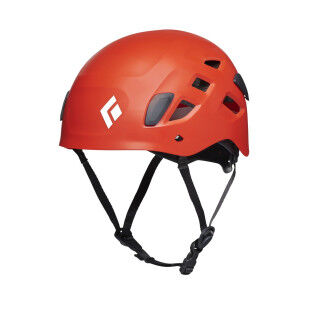
The hard-shell helmet is a classic. A hard ABS shell (a shock-resistant plastic) absorbs impacts by deforming slightly, while an inner foam layer dampens the remaining energy. Sturdy and durable, it handles side impacts very well—a common occurrence in climbing when you bump into the wall. Its weak point? It’s generally heavier (between 350 and 450 grams) and less well-ventilated than other models.
GOOD TO KNOW: The shell helmet is often the most affordable option in the range. Ideal for beginners or for occasional use on cliffs.
The EPS foam helmet
The foam helmet uses an EPS shell—expanded polystyrene (the same material found in bike helmets)—which absorbs impacts through compression. In other words, the foam compresses to dissipate energy. Result: much lighter helmets (often between 160 and 250 grams) with better ventilation. On the downside, they are less resistant to repeated impacts and side impacts, and are more easily damaged in the event of a fall or improper storage.
WARNING: A foam helmet that has suffered a significant impact must be replaced, even if it shows no visible damage. EPS foam compresses permanently and loses its shock-absorbing properties.
The hybrid climbing helmet
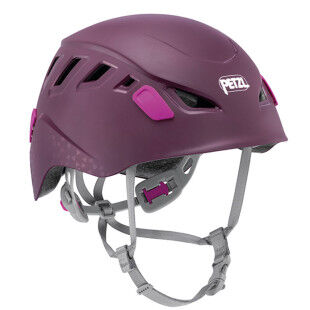
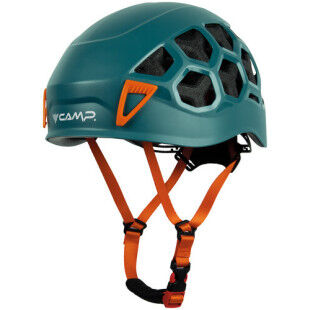
The best of both worlds: a lightweight outer shell (often made of polycarbonate) combined with an EPS liner on the inside. This construction offers good protection against frontal and side impacts, with a weight generally ranging from 220 to 320 grams.
This is currently the most popular category, and the one our team recommends for most climbers.
Things to Check When Buying a Helmet
Once you’ve identified the construction type, there are still specific criteria to compare before making a purchase.
EN 12492 certification for climbing helmets
Any climbing helmet sold in Europe must carry EN 12492 certification. This is the European standard that guarantees minimum protection against impacts from above and the sides, as well as resistance to penetration.
The EN 12492 standard tests impact resistance using a 5 kg mass dropped from a height of 2 meters. This is equivalent to a medium-sized rock falling from a standard height on a multi-pitch route.
Helmet Weight and Ventilation
Weight is often the first thing people look at. But it’s not the only factor in comfort. A lightweight helmet with poor ventilation can become a real ordeal on a multi-pitch route in direct sunlight.
Check the number and placement of the vents. The best models combine front and rear vents to create active airflow over the entire head.
The adjustment system
A poorly fitted helmet is a helmet that doesn’t provide proper protection. Adjustment systems vary from model to model:
- Rear dial: quick and precise adjustment, even with gloves on
- Adjustable straps only: less convenient, but often found on entry-level models
- Combination of dial and chin strap: the most comprehensive option for optimal fit
Always try on a helmet in-store. Head shapes vary greatly: some models are better suited for round heads, others for longer heads. Stop by one of our Speck-Sports stores—we’ll take the time to find the right fit for you!
Choose headphones that suit you
Remember the basics:
- A helmet with an ABS shell for beginners or for regular use on multi-pitch routes,
- A hybrid climbing helmet for everyday bouldering,
- A helmet with lightweight foam for climbers who want to forget they’re wearing a helmet...
Always check the helmet’s certification, test the fit in-store, and remember to check your helmet’s condition every season. Now it’s up to you!
Stop by our store in Bitschwiller-lès-Thann or at the Decathlon Village in Wittenheim—we’d love to let you try on our models. And if you’re still unsure, our team is here to help.