
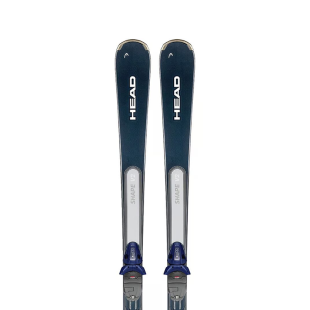
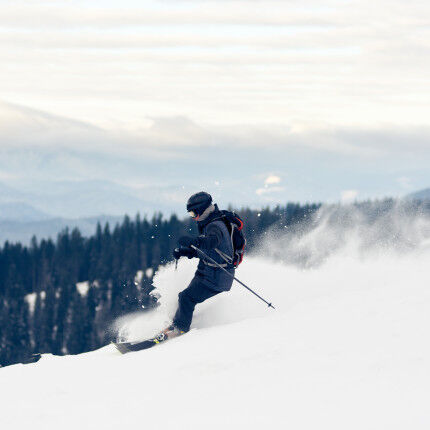
Which skis to choose for beginners?
You want to start skiing, but when you're a beginner you can quickly become overwhelmed by the amount of technical information you need to choose your first pair of skis. While at first glance you might think that a pair of skis is just a pair of skis, in reality it's much more complex, and each ski has its own specificities. Speck explains how to choose skis for beginners
The different types of skis and their specific features
Types of skis:
Skiing is a vast discipline, comprising many different types of skis. Here's a quick overview:
Downhill skiing
Downhill skiing is the most common type of skiing. It's practised in resorts, on marked, groomed pistes classified by level. It's best suited to beginners who want to progress.
All-mountain skiing:
All-mountain skis are more versatile and can be used on piste and off-piste. They are suitable for skiers of at least intermediate ability. They have a wider tip to "float" on powder when venturing off-piste, and adapt to all types of snow
Freeride and freestyle skiing:
Freeride and freestyle skiing is the practice of performing tricks on the mountain. Not suitable for beginners
Ski touring and cross-country skiing:
Ski touring and cross-country skiing are a combination of skiing and hiking. The idea is to ski up to the summit with a binding that allows you to "walk", and to ski down the slopes as if you were skiing off-piste. Ski touring or cross-country skiing is only possible when you are comfortable with skis
Choosing your beginner ski
The flex
When you're a beginner, you'll choose a ski with a softer flex, which makes it more forgiving. This allows you to forgive some of the mistakes you make when you're not used to skiing, such as placement errors or imbalances.
The radius
When we talk about curve radius, we're talking about the dimension lines defined by the size in mm of the tips and runner. To choose your skis, we'll take them with a so-called "X" radius, with a shorter curve and radius. With these skis, you'll be able to make turns more easily
Sizing
When it comes to size, it's best to choose skis that are shorter than your height in cm. The skis should be level with your nose, i.e. about 10cm shorter than your waist. Shorter skis are easier to handle, but longer skis offer greater stability.
Complementary equipment
Whether you're a beginner or an expert skier, it's important to have basic equipment, such as a ski helmet. In the event of an impact or fall, it's the first line of defence against serious injury. It would be a shame to have a bad experience during a week's skiing, especially when you're just starting out!
Ski selection

And if you rent your skis?
You can also rent your skis and test them before choosing a pair. This allows you to see if skiing is an activity you enjoy, and why not get to grips with rental skis so you can buy intermediate skis later. Speck offers a rental service in Alsace. It's the best way to find skis at your level, available immediately and at a great price.
At the Marsktein ski resort
Discover skiing in a family resort in the Vosges. You'll find our Speck rental store at the foot of the slopes. You can also enjoy a meal or snack at the nearby Le Tremplin restaurant.
In Bitschwiller-Lès-Thann
Speck has been the reference in the Vosges mountains since 1969. Meet our winter sports experts in our Speck boutique and Speck Outlet at the foot of the Vosges.
44 and 77B rue des Vosges 68620 BITSCHWILLER-LES-THANN
More articles to read

Updated on 06.01.2025
Hydro Flask bottles from Speck-Sports
Speck-Sports introduces you to Hydro Flask water bottles!
Updated on 08.07.2024
On the heights of Linthal
Explore the heights of Linthal on foot or on a run, and discover the Lac du Ballon, majestic waterfalls and maybe even some chamois!
Updated on 25.02.2025
Ardennes: La roche à Sept heures on the Monthermé loop
Discover the Roche à Sept Heures on the Monthermé loop, a natural gem offering panoramic views for an unforgettable hike.
Updated on 30.12.2024
Lyofood freeze-dried meals: a new horizon of flavours
Discover the new range of Lyofood freeze-dried meals: a palette of new flavours for your outdoor adventures.