
Why choose the Pyrenees for cross-country skiing?
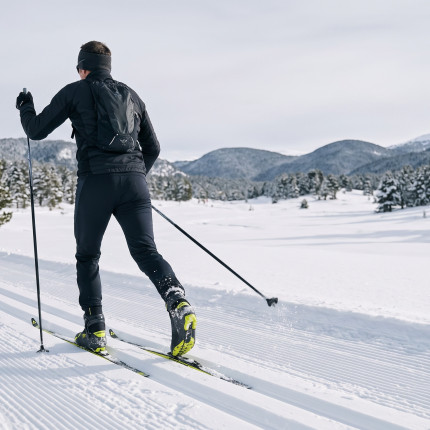
The Pyrenees are home to more than a dozen cross-country ski areas spread across the Pyrénées-Orientales, Ariège, Hautes-Pyrénées, and Pyrénées-Atlantiques departments. Cross-country skiing involves gliding along groomed trails—that is, trails prepared by a machine to ensure even snow coverage and well-defined tracks.
The region’s greatest asset is its atmosphere. You ski with the most beautiful peaks in front of you, often deep in the forest, with few people around and plenty of silence. The resorts are more intimate than the vast Alpine areas, and lift tickets remain affordable. As a rough guide, expect to pay around 13 to 14 € per day for an adult pass in the larger ski areas (2025–2026 rates; check before you go).
As for snow conditions, the higher elevations of the Pyrenean plateaus and plenty of sunshine often guarantee great conditions, generally from December through March, depending on the year.
There are two techniques in cross-country skiing. The classic (or “alternating”) style is practiced in parallel tracks, moving forward with a gliding stride. Skating (or the “skater’s stride”) is practiced on the smooth part of the trail, using a side-to-side motion similar to ice skating. The resorts almost always offer both styles on dedicated trails.
Pyrénées-Orientales: Sunshine and Wide-Open Spaces
This is the region of records. The Catalan Pyrenees offer high-altitude plateaus, plenty of sunshine, and forests of mountain pine.
Font-Romeu Pyrénées 2000: The Largest Nordic Ski Area in the Massif
With over 100 kilometers of trails (between 103 and 111 km, depending on the source), Font-Romeu is the largest Nordic ski area in the Pyrenees and one of the best in France. Perched above 2,000 meters in the Calme sector, the trails enjoy excellent snow conditions all winter long. The ski area holds the Nordique France certification, a label that recognizes the quality of its hospitality, trail marking, and trail maintenance.
It’s our top pick for skiers looking for variety: easy loops for beginners, challenging trails for experienced skiers, and even an introduction to biathlon (cross-country skiing combined with laser rifle shooting). The Cerdagne plateau also offers an exceptional panoramic view of the Carlit massif.
Capcir: Forests, tranquility, and a Canadian atmosphere
Just a few minutes from Font-Romeu and Les Angles, the Capcir Nordic Ski Area offers approximately 56 kilometers of trails around the Col de la Llose, at an elevation of 1,700–1,850 meters. The atmosphere here is more wooded and peaceful, with trails winding through the pine trees. The area is rated “4 Nordiques.” It’s an excellent choice for intermediate skiers and for anyone who prefers nature over big-name attractions.
Another advantage: a shared cross-country ski pass allows you to ski in several neighboring areas, and you can end the day in the region’s warm waters—a much-appreciated treat after a day on the slopes.
Ariège: The Untamed Ski Areas
Ariège is home to four high-quality ski areas, often described as the most authentic in the mountain range.
Plateau de Beille: The Far North of the Pyrenees
The Beille Plateau, at an altitude of 1,800–2,000 meters, is considered the premier cross-country skiing area in the Pyrenees. It’s accessible via a 16-kilometer road from the village of Les Cabannes, leading to a vast plateau with a 360° panoramic view of the mountain range. The resort offers about 40 kilometers of trails (the figure varies from 32 to 45 km depending on the source, as trail openings change with snow conditions), ranging from green trails for beginners to black trails for experienced skiers.
There are also two biathlon areas, as well as trails for snowshoeing and sledding. It’s an excellent choice for a family day out with members of varying skill levels.
Le Chioula, Mijanès-Donezan, and the Étang de Lers
Le Chioula, at 1,500 meters near Ax-les-Trois-Domaines, offers about 48 kilometers of cross-country ski trails set amid forests, plateaus, and valleys. It’s a multi-activity resort that’s very popular with families.
Mijanès-Donezan, nicknamed the “Little Quebec” of the Pyrenees, is a smaller area (15 kilometers) but one that’s particularly well-preserved. It’s the ideal spot for a peaceful first outing, away from the crowds.
Finally, L’Étang de Lers is a small area covering about 25 kilometers across four trails, set in a stunning location that also appeals to snowshoers.
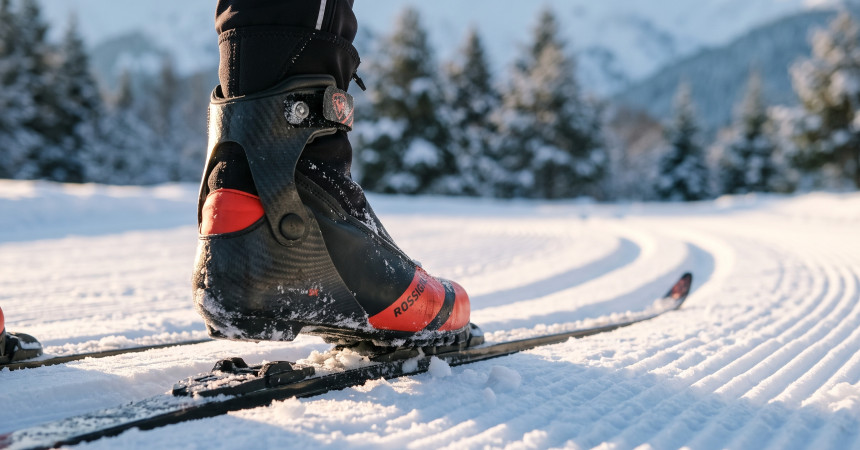
Hautes-Pyrénées: Val d'Azun, Payolle, and Nistos
The Hautes-Pyrénées is a cross-country skiing destination in its own right, with three key areas to keep in mind.
Val d'Azun, nicknamed “the Eden of the Pyrenees,” is the department’s largest cross-country skiing area, with about 90 kilometers of trails at an elevation of 1,350 meters. Its ten trails include green, blue, red, and black runs. It’s an ideal playground for spending several days exploring different routes without ever getting bored.
Payolle, nicknamed “Little Canada,” offers about 50 kilometers of marked trails through the forest and around the lake, at an altitude of 1,120–1,450 meters. The resort offers a superb view of the Pic du Midi de Bigorre and also hosts introductory sessions for biathlon, snowshoeing, and snow biking. An excellent destination for families.
Nistos, located between the Aure and Aran valleys, has about 43 kilometers of marked trails. It’s a very pleasant family-friendly resort, perfect for a laid-back day out. More modest in size, Peyragudes offers about 15 kilometers of cross-country trails and an introduction to biathlon—a great option if some family members prefer downhill skiing.
Pyrénées-Atlantiques: Beech Forests and the Border
In the Béarn and Basque Country regions, cross-country skiing takes on the feel of a long hike through the snow.
The Espace Somport, in the heart of the Pyrenees National Park in the Aspe Valley, is a 100% cross-country resort modeled after the Canadian style. Its trails, totaling about 25 kilometers, wind through beech forests and run along the Spanish border. The atmosphere is family-friendly and intimate, with a sauna and a hot tub on the terrace where you can admire the view.
Issarbe, in the Barétous Valley, charms visitors with its 360° panoramic views and varied trails. The Braca ski area, in La Pierre Saint-Martin, stretches from 1,450 to 1,540 meters through a beautiful forest. Finally, Iraty, in the highlands of the Basque Country, offers about 24 kilometers of cross-country trails and 23 kilometers of snowshoe trails in one of Europe’s most beautiful beech forests.
The figures for the number of kilometers of trails vary from one source to another and, above all, from one day to the next, as trail openings depend on snow conditions. Before heading out, always check the resort’s website or social media page to find out which trails are actually open and groomed.
Summary table: Which resort is best for which type of skier?
|
Ski Area |
Department |
Trails (approx.) |
Ideal for |
|
Font-Romeu Pyrénées 2000 |
Pyrénées-Orientales |
100 to 111 km |
All skill levels, variety, biathlon |
|
Capcir (Col de la Llose) |
Pyrénées-Orientales |
56 km |
Intermediate, forest setting |
|
Beille Plateau |
Ariège |
32 to 45 km |
Panoramic views, family-friendly, for active riders |
|
Le Chioula |
Ariège |
48 km |
Families, multi-activities |
|
Mijanès-Donezan |
Ariège |
15 km |
Beginners, peaceful setting |
|
Val d'Azun |
Hautes-Pyrénées |
90 km |
Vacations, all skill levels |
|
Payolle |
Hautes-Pyrénées |
50 km |
Families, biathlon |
|
Somport |
Pyrénées-Atlantiques |
25 km |
Nature, border atmosphere |
|
Iraty |
Pyrénées-Atlantiques |
24 km |
Basque Country, beech forest |
How to Prepare for a Cross-Country Skiing Trip
A great day of cross-country skiing starts long before you hit the trails. A few simple habits make everything easier.
Choosing the Right Gear
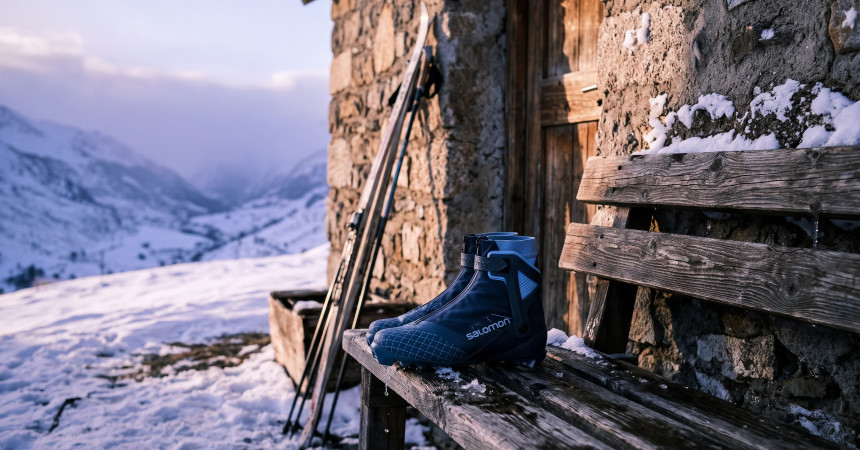
To start out, classic-style gear is the simplest: skis with scales or waxable bases, flexible boots, and lightweight poles. Wax is applied to the bottom of the ski to improve grip or glide, depending on the temperature. Clip-in skis, which have a scale-patterned base, don’t require waxing for uphill sections and are ideal for beginners. Skating-style skiing requires stiffer skis and boots that provide better ankle support.
When it comes to clothing, follow the three-layer principle: a breathable base layer that wicks away sweat, a mid-layer for warmth, and a windproof jacket. Cross-country skiing makes you sweat a lot, so it’s best to dress lightly and bring a warm layer for breaks.
Maintain your gear to make it last
Choosing durable gear also helps preserve our natural playgrounds. After each outing, wipe down your skis, let them dry at room temperature, and store them away from direct heat. Proper maintenance significantly extends the life of your equipment, and regular waxing keeps your skis performing at their best.
Conclusion
The Pyrenees offer a rare variety of Nordic ski areas. Font-Romeu for wide-open spaces and variety, the Plateau de Beille for its panoramic views, the Val d’Azun for a well-rounded trip, Payolle and Chioula for families, Mijanès-Donezan for a relaxed first outing, and the Basque Country for the atmosphere of a snow-covered forest.
Are you planning a cross-country skiing trip or looking to gear up for your first outings? Stop by our store—our team will take the time to discuss your plans with you.